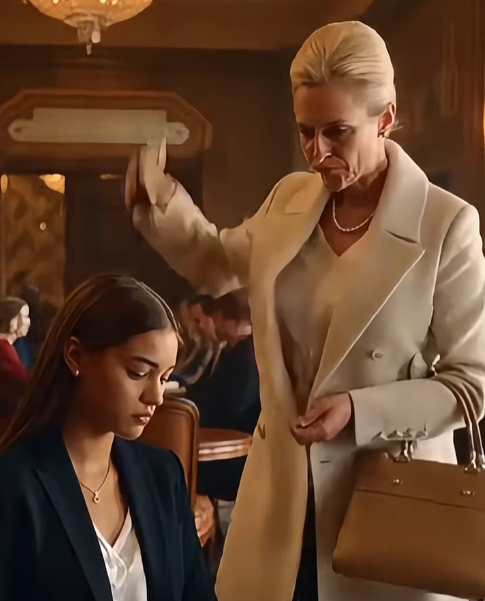

The moment the suited man’s words echoed in the air, the rich mother felt as if the ground beneath her heels had disappeared. Her mind struggled to process what she had just heard, replaying the sentence again and again. The confidence that once defined her posture dissolved instantly. Every pair of eyes around her now felt like a silent judgment pressing down on her.
Her lips parted, but no sound came out at first, as if her voice had abandoned her in that critical moment. The image of the slap she had just delivered flashed vividly in her mind. What once felt justified now burned like a public mistake she could not erase. The weight of realization hit harder than the act itself.
Slowly, she turned her gaze back to the young woman, who stood calm despite the red mark still visible on her cheek. That calmness now felt more powerful than any anger could have been. It wasn’t weakness—it was control. And that control made the mother feel even smaller.
“I… I didn’t know…” she finally stammered, her voice trembling and unfamiliar even to herself. The arrogance that once sharpened her tone had completely vanished. In its place was fear, raw and undeniable. Her words sounded hollow, even to her own ears.
She took a hesitant step forward, her hands slightly raised as if trying to fix something already broken. “I’m sorry… please… it was a misunderstanding,” she rushed out, her composure collapsing. The desperation in her voice grew more obvious with each word. But the damage had already been done in front of everyone.
The young woman didn’t respond immediately, her eyes steady and distant. There was no visible anger, but there was no forgiveness either. Her silence spoke louder than any confrontation could have. It created a space where the mother’s apology felt insignificant.
Without a word, the young woman turned toward the luxury car waiting by the curb. Her movement was smooth, controlled, and final. The suited man quickly stepped forward to open the door for her. The gesture was simple, but it reinforced her status without needing explanation.
The crowd instinctively stepped aside, clearing a path as if guided by an invisible force. Phones remained raised, capturing every second of the unfolding moment. What had started as a confrontation was now becoming a spectacle. And the mother was at its center—for all the wrong reasons.
“Wait—please!” the mother called out, her voice cracking as she reached forward. But the young woman didn’t turn back. Not even a glance. The distance between them grew with each step she took.
She entered the car without hesitation, her expression unreadable as the door closed softly behind her. The engine started, smooth and quiet, in sharp contrast to the chaos left on the sidewalk. The car pulled away, leaving behind silence heavier than before. And with it, any chance of immediate forgiveness disappeared.
The mother stood frozen, her hand still slightly raised in the air. The realization that she had just struck the mayor’s daughter settled deeply into her chest. It wasn’t just a mistake—it was a public humiliation of someone far beyond her reach. Her breath became shallow, uneven.
Around her, whispers began to grow louder, no longer subtle or hidden. “Did you see that?” someone murmured. “That’s the mayor’s daughter…” another voice added. The words spread like wildfire through the crowd.
Within minutes, clips of the incident were already being shared online. Different angles, different voices, but the same undeniable moment—her slap, her insults, her collapse. The internet didn’t need time to judge. It reacted instantly.
Meanwhile, inside the car, the young woman sat quietly, staring ahead. Her cheek still stung, but her composure remained intact. She reached for her phone, typing a short message with steady hands. It was simple, direct, and sent to only one contact—her father.
Across the city, in a secured office, the mayor read the message in silence. His expression hardened with every word. The room around him seemed to grow colder as the reality set in. His daughter had been humiliated—publicly.
He stood up slowly, his decision already forming before anyone could ask. “Cancel everything,” he said firmly. His voice carried no hesitation. “And find out everything about that woman.”
Back at the sidewalk, the rich mother’s phone began to vibrate nonstop. Notifications flooded in—messages, missed calls, alerts. Her social media was already exploding with reactions. People she didn’t even know were now speaking about her.
Her colleagues saw it too. The company she proudly represented began receiving calls within the hour. Clients questioned their values. Partners demanded explanations. Reputation, built over years, started crumbling in real time.
By the next morning, she was called into an emergency meeting. The faces around the table were no longer friendly or respectful. They were distant, cautious, and decisive. The outcome was already clear before anyone spoke.
“We can’t be associated with this,” one executive said coldly. No one argued. No one defended her. The silence that followed was final.
Her position was terminated immediately. No negotiations, no second chances. Just a formal statement and a security escort out of the building she once walked into with pride. The fall was swift and absolute.
At the same time, her son received a call from the mayor’s office. The message was short and direct. The relationship was over. There would be no further contact.
He tried to protest, to explain, but the decision wasn’t his to make anymore. The influence and authority behind it were undeniable. His voice meant nothing against that level of power.
The mother watched everything unravel, piece by piece, with no way to stop it. Her name, once respected, became a headline of disgrace. Every replay of the video reminded her of the exact moment everything changed. And there was no escaping it.
She sat alone that evening, the silence of her home heavier than any crowd’s judgment. No calls, no support, no reassurance. Only the echo of her own actions returning to her again and again.
For the first time, she understood something she had never considered before. Power wasn’t in wealth, appearance, or status. It was in how you treated people when you believed they were beneath you.And that lesson came at a cost she could never undo.